

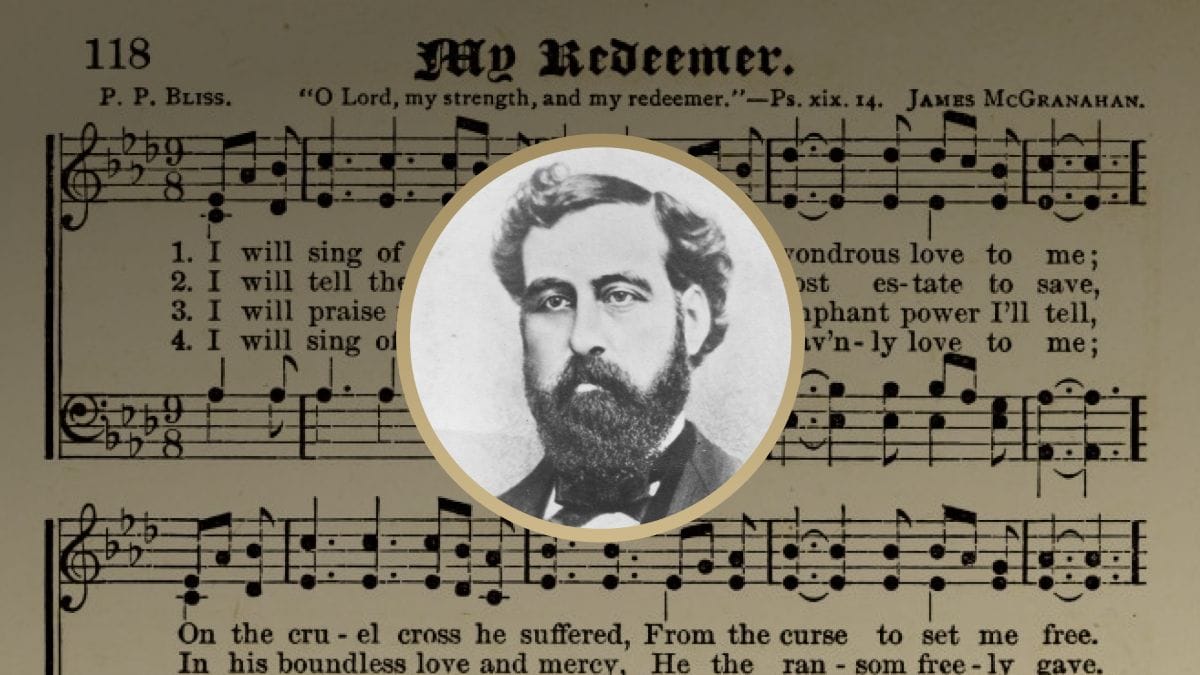
Philip Paul Bliss was born in a log house on a farm near Penfield, Pennsylvania. He entered the world on July 9, 1838. It is very fitting that his family name “Bliss” was bequeathed to him by a long line of Christians who lived in the joy and bliss that only Jesus can bring. His Godly parents were Isaac and Lydia Bliss. They were poor, but they were happy in Jesus.
Throughout his life, from cheerful boyhood to tragic death in a fiery train wreck, Philip Bliss was known as a man who radiated the joy of Christ. George Root, a fellow musician and close associate, said of Bliss, “His smile went into his religion and his religion into his smile.”
In His Upper Room Discourse, Jesus linked joy with constant abiding in the living presence of Christ. Immediately after the discussion of the vine and the branches, our Lord said, “If ye keep my commandments, ye shall abide in my love; even as I have kept my Father’s commandments, and abide in his love. These things have I spoken unto you, that my joy might remain in you, and that your joy might be full (John 15:10–11). True bliss comes from abiding in the living presence of Christ.
For Philip Bliss, that joy was instilled at a very early age. He described his father with glowing words of tribute—that his father was “always happy, always singing.” Growing up in this Godly home, Philip Bliss never could remember the day that he did not know and love his Redeemer. Like many who grow up in Godly homes, he did not have a dramatic story of conversion. He simply trusted in Jesus at a young age and tried to serve the Master all his life.
Bliss loved music as long as he could remember. As a boy, he emulated his father by singing all the time. He even made some crude musical instruments by hand! As a teenager, he worked in lumber camps and sawmills. Among rough, burly lumberjacks, Bliss lived a consistent Christian life and brought joy to all that knew him.
Friends soon recognized that this lad possessed remarkable talents in music. A kind patron named J. G. Towner heard him sing and offered to give him voice lessons. He also sent the young singer to a music convention where Bliss met William Bradbury, a famous composer of hymns. These new connections opened the door for Philip Bliss to take a position in 1858 as a music teacher in Rome, Pennsylvania.
It was in Rome that Bliss met a young lady named Lucy J. Young. She shared Bliss’s love for music, and the two young people formed a deep friendship that blossomed into love. The two were married on June 1, 1859. Throughout Bliss’s career as a writer, composer, and music teacher, his beloved wife Lucy supported and encouraged him in his work for the Lord. They had a happy and truly blissful marriage.
During the early days of his marriage, Bliss became an itinerant music teacher. Mounted on his horse, he rode from community to community, teaching singing schools and music lessons to all who were interested. He and his wife lived on what little money could be made by these lessons during the dark days of the War Between the States.
Near the end of the war, as the bloody struggle bled the states of their best manhood, Philip Bliss received a draft notice. He was inducted into the 149th Pennsylvania Infantry. The war came to a close before he actually saw any battlefield action. Following the war, Bliss was given a job working for Root and Cady Musical Publishers in Chicago.
Bliss worked with D. L Moody from time to time, and the evangelist encouraged and appreciated the young musician. However, Moody already had Ira Sankey as his primary musical associate. Meanwhile, another evangelist, Daniel Whittle, asked Bliss to assist him in his preaching efforts.
Philip Bliss wrote in his journal, “Now I am fully persuaded that God calls me to give my time and energies to writing and singing the Good News. I am constrained by what Christ is and has been to me, to offer all my powers directly to His sweet service. Major Whittle goes with me to preach the Gospel while I try to sing it.”
It was this friendship with Whittle that gave rise to the famous hymn, “Hold the Fort,” which inspires the Christian with the assured knowledge of the victorious return of Christ. Daniel Whittle, a former officer in the Union Army, told a story of General Sherman sending a message from Kennesaw Mountain to a surrounded Federal supply base that was threatened with seizure by Confederate soldiers. The message to the besieged Union troops, waved by signal flag, said, “Hold the fort; I am coming.”
Based upon Whittle’s story, Bliss wrote a hymn describing how the coming of the Lord Jesus inspires us with courage and joy as we anticipate His glorious victory.
Ho, my comrades, see the signal, waving in the sky!
Reinforcements now appearing, victory is nigh.
“Hold the fort, for I am coming,” Jesus signals still;
Wave the answer back to heaven, “By Thy grace we will.”
Over the course of almost a decade, Philip P. Bliss authored or composed approximately 300 hymns. Some of the best known ones include “Let the Lower Lights Be Burning,” “Almost Persuaded,” and “Hallelujah! What a Savior!” Bliss seemed to have had a special love and interest in the coming of the Savior. He also wrote the tune for the memorable text composed in a time of tragedy by his friend, Horatio Spafford. Spafford’s famous hymn is “It Is Well with My Soul.”
Philip and Lucy Bliss were blessed with two sons, George and Philip Paul Jr. When the boys were still very young, aged four and one, Philip and Lucy Bliss were invited to come by train and participate in a revival service being preached by Daniel Whittle in Chicago.
The date was just after Christmas, December 29, 1876. Philip and Lucy Bliss were riding in a train car bound for Chicago. As the locomotive crossed a bridge over the Ashtabula River in Ohio, the bridge suddenly collapsed without warning. The first locomotive made it across the bridge, but all the passenger cars and the baggage crashed into the deep ravine. Lanterns that had been in use on the train set the wreckage ablaze.
It is reported that Philip Bliss was able to escape from the wreckage. However, not finding his beloved Lucy, he went back into the blazing cars to rescue her. Neither emerged, nor were their bodies ever found in the charred rubble. Amazingly, Bliss’s trunk endured the fire unscathed. In it was found a manuscript with these words:
I will sing of my Redeemer
And His wondrous love to me;
On the cruel cross He suffered,
From the curse to set me free.
Sing, O sing of my Redeemer!
With His blood He purchased me;
On the cross He sealed my pardon,
Paid the debt, and made me free.
Sources and Further Reference:
Whittle, D. W. Memoirs of Philip P. Bliss. London, UK: Forgotten Books, 1877.


 23:24